Wednesday, January 12, 2011

50 CALIBER DEPLETED URANIUM BULLETS


The 50 caliber depleted uranium shells that the American government has been trying to implement in their military operations for the past seventy years are highly dangerous.


Depleted uranium as it stands has a high level of toxicity, is radioactive and can adversely affect people.

The American military however, is remarkably fond of these effective armor piercing rounds.

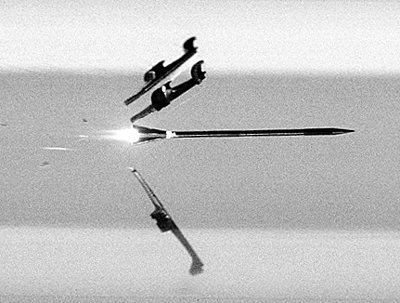
Depleted Uranium, when crafted into the tip of a bullet or tank round will not mushroom or splatter on impact.

Instead the shell will shear off parts of the heavy metal casing, making it sharper, and cause the shell to completely pierce the target, be it an enemy tank or land vehicle.

The government has advocated the use of this heavy metal and purposefully ignored the toxic warnings that come with it.

This is because the shadow government wants their ammunition to kill the maximum amount of people and if this means poisoning them after the war has ended - then so be it.

Depleted uranium, when in contact with humans causes a multitude of cancers, diabetes, breathing problems, blindness, deformity in children and mental illness.

One of the greatest examples of depleted uranium poisoning was during the Gulf war.
50 CALIBER DEPLETED URANIUM SHELLS: THE REAL WEAPONS OF MASS DESTRUCTION

These 50 caliber bullets are able to do a massive amount of damage. So much in fact, that the use of such ammunition is illegal. Depleted uranium shells are nothing more than nuclear weapons. They cause the same amount of damage as a warhead, just on a smaller scale.

Take for example the toxicity of a bullet. This bullet will impact on a target and remain mostly intact, falling to the ground for people to pick up or for children to play with. This heavy metal is extremely harmful to our health.

On impact this bullet gives off a fine radioactive dust that when ingested can cause all of the illnesses mentioned above. This is chemical warfare and it has been conducted illegally by the United States government in their bid to depopulate the earth.

Τι κόσμος είναι αυτός που ψάχνει στο φεγγάρι να βρει αλήθεια στο κενό τι κόσμος είναι αυτός που πάει στο φεγγάρι και τα παιδιά του πολεμά

"Οι ΜΟΝΤΑΖ που στα πρώτα βήματά τους λέγονταν ΝΟΚ ΑΟΥΤ, έκαναν την εμφάνισή τους το 1989.Εκείνη την περίοδο, κυκλοφορεί ένα πρώτο DEMO με την ονομασία ΜΟΝΤΑΖ, ενώ δύο χρόνια αργότερα ηχογραφούν ένα maxi single με τρία τραγούδια. Ακολουθούν αρκετές συναυλίες στις οποίες οι ΜΟΝΤΑΖ δίνουν τον καλύτερο εαυτό τους, πράγμα που οδηγεί τους κριτικούς να τους κατατάξουν στα ανερχόμενα ροκ συγκροτήματα.
Το καλοκαίρι του 1997, σε συνεργασία με την LEGEND, οι ΜΟΝΤΑΖ κυκλοφορούν το πρώτο ολοκληρωμένο άλμπουμ τους με τίτλο: «ΤΙ ΚΟΣΜΟΣ ΕΙΝΑΙ ΑΥΤΟΣ».Το 2000 κυκλοφορούν ένα καινούριο άλμπουμ με τίτλο NAMASTE.παραγωγή και διανομή ΜΟΝΤΑΖ.


Οι ΜΟΝΤΑΖ ειναι:

Νίκος Πασχάλης (τραγούδι)
Μανώλης Παπουλιάς (κιθάρα)
Αντώνης Κουιμτζής (μπάσο)
Μανώλης Σαμαράς (ρυθμική κιθάρα)
Γιάννης Βουλγαράκης (τύμπανα)

Διαφορετικοί χαρακτήρες, διαφορετικές επιρροές, χώροι και χρόνοι που ανταμώσανε δύση και ανατολή, σκέψεις και ταξίδια που τρακάρανε σε πεζές εικόνες ενός κούφιου συστήματος.
Οι ονειροβασίες απέναντι στη διαμαρτυρία, η σιωπή δίπλα στην κραυγή.
Ο ιδρώτας της πρόβας μ’ αυτόν της συναυλίας και τέλος ακριβώς ίδιος και στο στούντιο.
Ηδη δεκαπέντε χρόνια παρουσίας και άλλα τόσα στο μέλλον, μονταρισμένα στο ίδιο μονοπάτι, στο ίδιο σύννεφο, στην ίδια μουσική.
Το "ΤΙ ΚΟΣΜΟΣ ΕΙΝ ΑΥΤΟΣ" είναι αφιερωμένο στον παραλογισμό της λογικής των δίποδων ζώων, πάνω στην οποία λογική, στηρίχθηκαν και θα στηρίζονται τα χειρότερα εγκλήματα μέχρι τον τελικό αφανισμό."

Νίκος Πασχάλης
Πηγη και κατεβασμα αλμπουμ: εδω

Τι κοσμος ειναι αυτος Lyrics

Τι κόσμος είναι αυτός
που ψάχνει στο φεγγάρι
να βρει αλήθεια στο κενό
τι κόσμος είναι αυτός
που πάει στο φεγγάρι
και τα παιδιά του πολεμά

Ε ουρανέ
κάθισε μαζί μας
κάτσε ν' ακούσεις μια πενιά
φίλε παλιέ
μην προσπαθήσεις
να μας κεράσεις μαχαιριά
Τι κόσμος είναι αυτός
πουλάει συνειδήσεις
καταβροχθίζει συνεχώς
τι κόσμος είναι αυτός
που πλημμυρίζει δάκρυ
τι δακρυσμένος ουρανός

Ηθοποιοί που παίζουν
που παίζουν κάποιο ρόλο
σε μια απέραντη σκηνή
νεκρομανείς γυρεύουν
γυρεύουν να τους δώσεις
σε κάποιο ηρώο προτομή

Monday, November 1, 2010

Μισιρλου !!!!!!!!!!

Κατά το 1927 ο τρις-μεγιστος Τέτς Δημητριάδης απο την Πόλη ηχογραφεί στην Νέα Υόρκη τη μισιρλου, ενα απο τα πλέον επιτυχιμένα ρεμπέτικα της εποχής....

απόλαυση


Sunday, October 24, 2010

What about changing the Euler with SPH ! ! ! !

High-pressure die casting is an important process in the manufacturing of high-volume and low-cost automotive components such as automatic transmission housings and gear box components. Liquid metal (generally aluminum or magnesium) is injected into the die at high speeds (30 m/s to 100 m/s) and under high pressure through complex gate and runner systems. The geometric complexity of the dies leads to strongly three-dimensional (3-D) fluid flow with significant free-surface fragmentation and splashing. The order in which the various parts of the die fill and the positioning of the air vents are crucial to forming homogeneous cast components with minimal entrapped voids. This is influenced by the design of the gating system and the geometry of the die. Numerical simulation offers a powerful and cost-effective way to study the effectiveness of different die designs and filling processes, ultimately leading to improvements in both product quality and process productivity, including more effective control of the die filling and die thermal performance.

Smoothed-particle hydrodynamics (SPH) is a Lagrangian method for modeling heat and mass flows. Due to its mesh-free nature and the handling of boundaries using SPH nodes, this method can handle complex splashing and fragmenting free surface flows and the motion of multiple solid equipment parts relatively easily. In traditional mesh-based methods used in commercial fluid-flow packages, large mesh deformations are generated by the motion of the equipment, leading to significant numerical problems. In addition, the tracking of the free surface is diffusive and inaccurate for the resolutions used.

For SPH, materials are discretized into particles that can move subject to equations of motion arising from the governing partial differential equations. The particles are moving interpolation points that carry with them (convect) physical properties and state information, such as the mass of the fluid that the particle represents, its temperature, momentum, enthalpy, density, and other properties. The inter-particle forces are calculated by smoothing the information from nearby particles in a way that ensures that the resultant particle motion is consistent with the motion of a corresponding real fluid, as determined by the governing equation (e.g., the Navier-Stokes equations).

MORE INFO
http://www.youtube.com/watch?v=wVmNdRcucxY

Monday, August 23, 2010

RamJets

Many people confuse ramjets with pulsejets and are unaware that although both are quite simple and somewhat similar in design, they vary significantly in the way they operate and the tasks for which they are suitable.

Ramjets have no moving parts -- much like a valveless pulsejet but they operate with cotinuous combustion rather than the series of explosions that give a pulsejet its characteristic noise.

On the face of it a ramjet would seem to be the ideal kind of jet -- no spinning turbines, no vibrating valves and a seemingly ultra-simple construction.

Unfortunately there are two things that work against the ramjet:

1. Operating Speed
Unlike pulsejets and jet-turbine engines, the ramjet will not operate unless it is moving through the air at a speed of at least 400 mph.

If you attempt to start a ramjet while it's stationary or moving to slowly then it will give little or no thrust -- in fact you'll just get lazy, smokey flames billowing out both the intake and exhaust.

This is because a ramjet relies on heating a fast-moving stream of cold air as it enters the engine and then expelling that air at a higher speed out the back. Unless the engine is moving rapidly through the air there's nothing for the burning fuel to heat.

2. Fuel Consumption
As a general rule of thumb, the fuel-efficiency of an internal combustion engine is related to the compression ratio at which it operates. That is to say -- the more the air/fuel mixture is compressed before it is ignited then the more power you'll get from a given amount of fuel.

Diesel engines have a compression ratio of about 20:1, most car engines operate at compression ratios as high as 11:1, a pulsejet runs at a compression ratio of less than 2:1 and ramjets are about the same at low speeds.

As a result, the ramjet (like the pulsejet) is not a particularly fuel-efficient engine. What makes it worse is that since the ramjet needs to be operated at very high speed, it's going to have to burn a lot of fuel just to overcome the drag it creats at that speed.

Can Ramjets Be Home-built?
Yes -- it's quite possible to build a ramjet using the kind of tools you'd find in a reasonably well equipped home workshop -- but why bother?

Unless you're going to be using it at a minimum speed of 400 mph it will be nothing but a paperweight.

There are some companies that offer to sell you the plans for a ramjet and a helicopter which is powered by these jets affixed to the tips of the rotor blades.

Many people have bought these plans, few have built the engines or helicopters and, to the best of my knowledge, nobody has ever reliably flown one.

What is ignored by such designs are the problems of fuel-efficiency and the fact that the rotorblades of such a helicopter would have to be spun up to almost full RPMs before the ramjet would even operate. This would require significant power to "spin-up" the rotor system and add to the cost and complexity of such a project.

So, I'd advise readers that such projects are an interesting curiosity -- but don't expect that you will end up with a jet-powered craft capable of flying safely or reliably.

So Where Are Ramjets Actually Used?
Subsonic ramjets are seldom (if ever) used these days but more modern hybrid turbjet/ramjet engines have been used in the ultra-high speed SR71 Blackbird.

Many of the low-orbit reusable space vehicles are now considering the use of scramjets for their power-plant while still in the earth's atmosphere but even scramjets remain largely the domain of the drawing board.

Scramjets differ from ramjets insomuch as the airflow inside the engine remains supersonic -- whereas conventional ramjets slow the incoming air down to a much lower speed so that its pressure is increased and it is easier to burn regular fuels.

Saturday, May 29, 2010

Simulations for the Naval Industry

By using the top mesh engine Hypermesh, we can provide the best mesh for the unique solver Radioss, then by setting up a model with 2 millions nodes of SPH we can simulate perfect simulation of any naval construction like LPG tankers.

Friday, January 8, 2010

Altair Engineering product HyperMesh for Casting simulations

The High end mesh engine is used for creating a special mesh for simulate the casting process on naval equipment.

One of the most difficult part for manufacturing in the naval industry is the propellers, due to the thick blades and the big dimensions that can reach the 9 meter diameter, it is very familiar under the casting of the part to have a solidification of the liquid metal at the blades, also porosity and deformation of the part under the cooling and also the the stresses that can generated between the casting part (propeller) and the mold (sand) , can create a failure in the production part, to take the advantage in the market by creating a high end product faster and with the best quality it is necessary to use the best technology for simulate the propeller before try to make the casting part.


By using the simulation in the manufacturing of propeller we can take information that are not reachable otherwise, in less that 5 days the engineers can simulate several times the model and also apply another parameters like temperature of the liquid, velocity of the inlet, the need for chills or vents, the design of the mold and also the deformation of the propeller under the cooling time, to take a look if this deformation is in the limits that the developer accept.